Language guide
Italian phrases for Calabria
About 30 Italian phrases will carry you through a week in Calabria: greetings, ordering, paying, getting around and asking for help. Use the polite Lei form with anyone you don't know, open every exchange with "Buongiorno" or "Buonasera," and say "grazie" often. Every Calabrian also speaks standard Italian, so you don't need dialect, though a word like "rumàni" (tomorrow) will earn a smile.
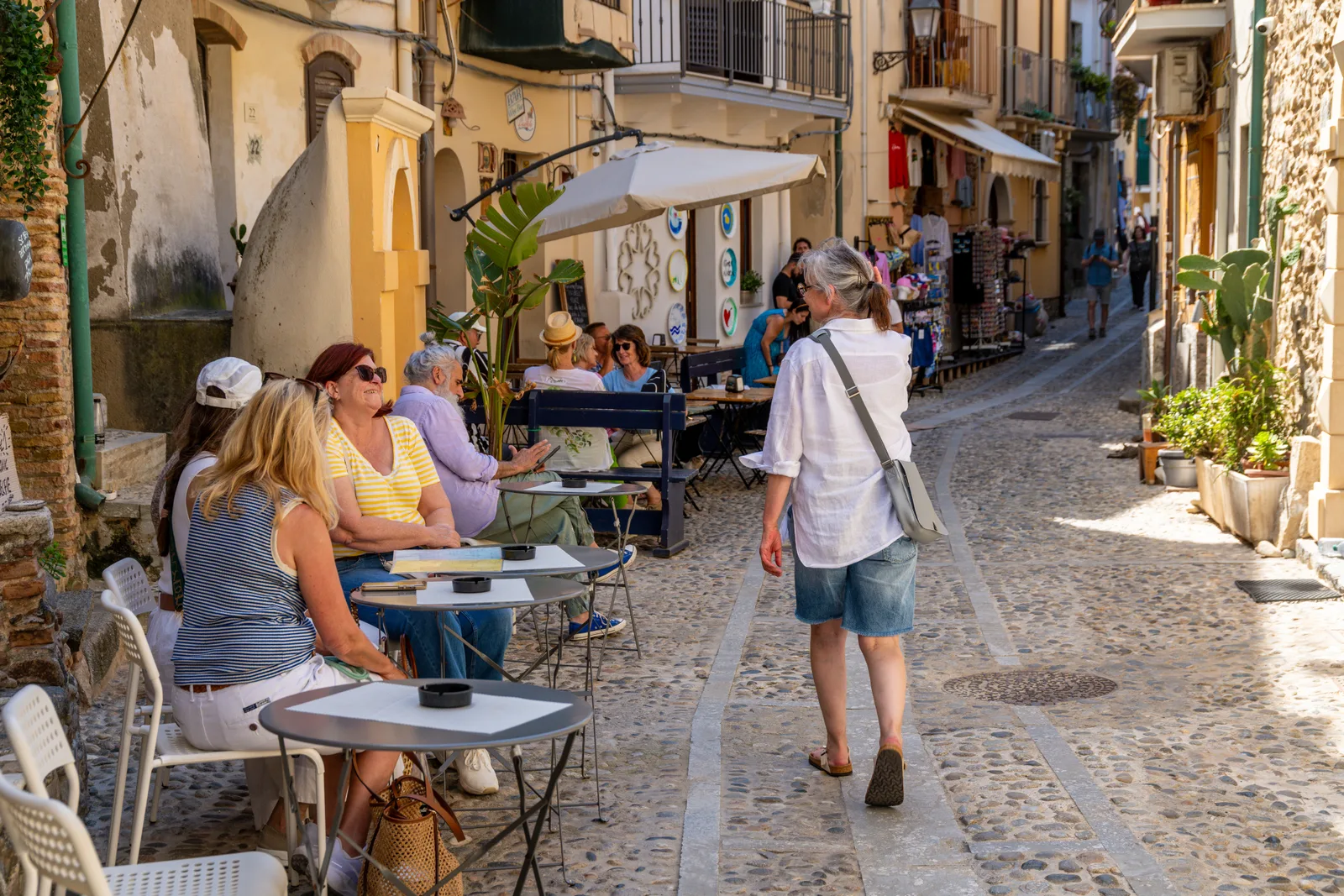
Greetings and courtesy words to use every day
Courtesy words do more work than any other Italian you learn. Greet before you ask, in shops, bars and offices alike. Use the polite Lei form with anyone you don't know, whatever their age, and keep the familiar tu for friends and children; all the phrases on this page are in the polite form.
| Italian | Pronunciation | Meaning |
|---|---|---|
| Buongiorno | bwohn JOHR-noh | Good morning, hello (until mid-afternoon) |
| Buonasera | bwoh-nah SEH-rah | Good evening, hello (from mid-afternoon) |
| Salve | SAHL-veh | Hello, polite and neutral at any hour |
| Per favore | pehr fah-VOH-reh | Please |
| Grazie / Grazie mille | GRAHT-tsyeh / GRAHT-tsyeh MEEL-leh | Thank you / Thanks so much |
| Prego | PREH-goh | You're welcome; also "go ahead" |
| Mi scusi | mee SKOO-zee | Excuse me, sorry (polite) |
| Permesso | pehr-MEHS-soh | Excuse me, may I get past |
| Arrivederci | ahr-ree-veh-DEHR-chee | Goodbye |
At the bar and at the table
These phrases cover breakfast at the bar through dinner and the bill. Women speaking about themselves use the feminine ending, so it is allergica and vegetariana, not allergico and vegetariano.
| Italian | Pronunciation | Meaning |
|---|---|---|
| Un caffè, per favore | oon kahf-FEH, pehr fah-VOH-reh | An espresso, please |
| Un tavolo per due | oon TAH-voh-loh pehr DOO-eh | A table for two |
| Acqua naturale / frizzante | AHK-kwah nah-too-RAH-leh / free-DZAHN-teh | Still / sparkling water |
| Che cosa mi consiglia? | keh KOH-zah mee kohn-SEE-lyah | What do you suggest? |
| Sono allergica a... | SOH-noh ahl-LEHR-jee-kah ah | I'm allergic to... (said by a woman) |
| Sono vegetariana | SOH-noh veh-jeh-tah-RYAH-nah | I'm vegetarian (said by a woman) |
| Senza glutine | SEHN-tsah GLOO-tee-neh | Gluten-free |
| Il conto, per favore | eel KOHN-toh, pehr fah-VOH-reh | The bill, please |
| Posso pagare con la carta? | POHS-soh pah-GAH-reh kohn lah KAHR-tah | Can I pay by card? |
Getting around: trains, taxis and directions
Calabria's regional trains and small stations are where English runs thinnest, so these are worth practicing before you arrive.
| Italian | Pronunciation | Meaning |
|---|---|---|
| Dov'è la stazione? | doh-VEH lah stah-TSYOH-neh | Where is the station? |
| Dov'è il bagno? | doh-VEH eel BAHN-yoh | Where is the restroom? |
| Quanto costa? | KWAHN-toh KOHS-tah | How much is it? |
| Un biglietto per Pizzo | oon bee-LYEHT-toh pehr PEET-tsoh | A ticket to Pizzo |
| A che ora parte? | ah keh OH-rah PAHR-teh | What time does it leave? |
| Mi può chiamare un taxi? | mee pwoh kyah-MAH-reh oon TAHK-see | Could you call me a taxi? |
| A destra / a sinistra / sempre dritto | ah DEHS-trah / ah see-NEES-trah / SEHM-preh DREET-toh | Right / left / straight ahead |
Help, health and when you don't understand
Save these in your phone's notes; they are the ones you need fastest.
| Italian | Pronunciation | Meaning |
|---|---|---|
| Parla inglese? | PAHR-lah een-GLEH-zeh | Do you speak English? |
| Non capisco | nohn kah-PEES-koh | I don't understand |
| Può parlare più lentamente? | pwoh pahr-LAH-reh pyoo lehn-tah-MEHN-teh | Could you speak more slowly? |
| Mi sento male | mee SEHN-toh MAH-leh | I feel unwell |
| Dov'è la farmacia? | doh-VEH lah fahr-mah-CHEE-ah | Where is the pharmacy? |
| Ho perso il passaporto | oh PEHR-soh eel pahs-sah-POHR-toh | I've lost my passport |
| Aiuto! | ah-YOO-toh | Help! |
Five pronunciation rules that fix most mistakes
Italian is spelled almost exactly as it sounds, so a handful of rules gets you most of the way.
- C and G soften before E and I. "Ci" sounds like "chee," "ge" like "jeh"; before A, O and U they stay hard, as in "casa" and "gola."
- CH and GH are always hard. "Chiesa" (church) is KYEH-zah, never with an English "ch."
- GN sounds like the ny in canyon, as in "bagno," and GLI like the lli in million, as in "biglietto."
- Double consonants are held longer. "Nonno" (grandfather) and "nono" (ninth) are different words, so lean on the double N.
- Every vowel is spoken, including the final one: "pane" (bread) is PAH-neh, never "pain," and "grazie" ends on a clear "eh."
A few Calabrian dialect words, and how dialect works here
Dialect is still the language of home in Calabria. In ISTAT's survey of languages in Italy, 68.6% of Calabrians said they speak dialect in the family, alone or alongside Italian, and only 25.3% speak mainly Italian at home, one of the lowest shares in the country. Linguists split the region in two: Northern Calabrian, around Cosenza, is close to Neapolitan, while the Central-Southern varieties spoken across most of the region, including the province of Vibo Valentia, belong with Sicilian.
Greek, once widely spoken in southern Calabria, left a strong mark on the Central-Southern dialects. A few from the Central-Southern varieties:
- Rumàni: tomorrow (Italian "domani").
- Purtuàllu: orange, the fruit, from Greek (Italian "arancia").
- 'Nnaca: cradle, also from Greek.
- Avantèri: the day before yesterday (Italian "l'altro ieri").
Planning Calabria?
Hear when 2027 dates open
A small group of women, one week in Tropea, everything arranged. Join the list for first word on dates and an occasional letter from Calabria.
One email when 2027 dates open, and an occasional letter from Calabria. Unsubscribe any time.
Questions
Should I use Lei or tu in Calabria?
Use Lei, the polite form, with anyone you don't know, including shop staff, servers and older people. If someone switches to tu with you, you can follow. Using Lei by mistake is never rude; using tu too early can be.
When do Italians switch from buongiorno to buonasera?
From around mid-afternoon onward, though there is no fixed hour and usage varies from person to person. If in doubt, "salve" works at any time of day.
Will Calabrians understand my standard Italian?
Yes. Basically every Calabrian also speaks standard Italian, and they will use it with visitors. You may hear dialect between locals, at the market or around a family table, but you are not expected to speak it.
Is it worth learning Italian before a one-week trip?
A little goes a long way. Greetings, numbers and the phrases on this page are enough to order, pay and travel, and opening in Italian before asking for English changes the tone of most exchanges.
Sources and further reading
- Wikivoyage: Italian phrasebook
- Wikipedia: Calabrian dialects
- ISTAT: L'uso della lingua italiana, dei dialetti e delle lingue straniere (2015 data)
- Wikivoyage: Calabria, Talk
Checked November 19, 2026. Timetables, prices and opening hours change; confirm before you travel.
Keep reading
Related guides