Tropea landmark
Tropea Cathedral and the Madonna di Romania
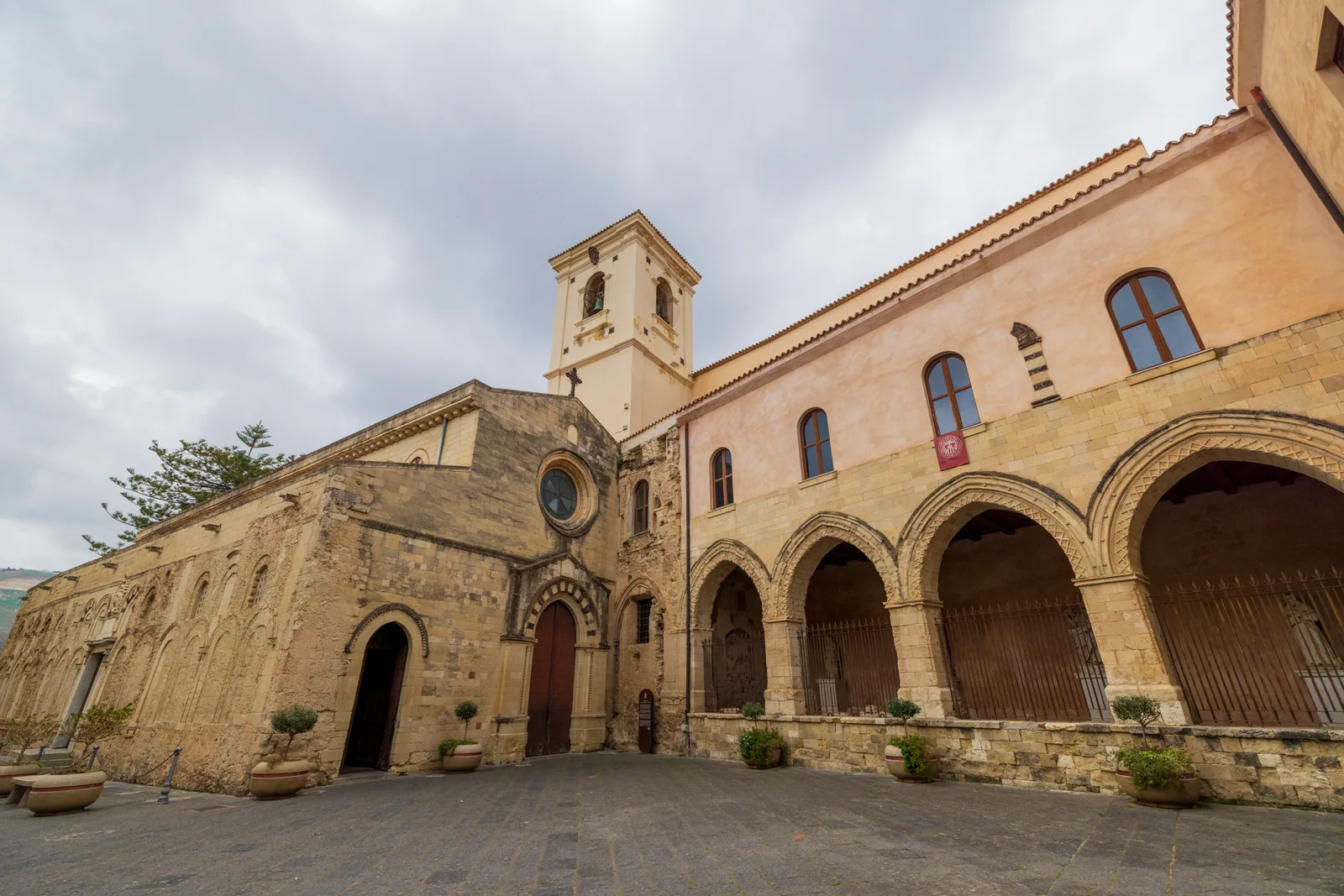
Tropea's cathedral is a Norman church of the 12th century in the old town's Largo Duomo, now a co-cathedral of the diocese of Mileto-Nicotera-Tropea, and it is free to enter. Its heart is the icon of the Madonna di Romania, the town's patron, said to have arrived by ship from the East. Tropea honors her on 27 March, the anniversary of the 1638 earthquake, and with a procession on 9 September, the anniversary of the icon's crowning in 1877.
What should you look for inside Tropea Cathedral?
Start with the icon, then walk the three naves slowly. The building is plain by Italian standards, in yellowish tuff and dark lava stone, which makes the few objects inside stand out.
- The icon of the Madonna di Romania, the patron of Tropea and the reason the church is also a diocesan Marian shrine, a status granted by decree on 31 May 2002.
- Two unexploded bombs from September 1943, when American aircraft dropped six bombs on the town and none went off. Tropea credits its patron, and the bombs are displayed inside.
- The Black Crucifix (Crocifisso Nero), a large crucifix probably made in France and dated no earlier than 1600.
- A Madonna and Child dated 1555 and the funerary monument of the Guzetta family.
- The relics of Santa Domenica, the saint born in Tropea, whose feast falls on 6 July.
- The tombs of two local figures: the philosopher Pasquale Galluppi and Blessed Francesco Mottola, the priest beatified on 10 October 2021.
- A Tamburini pipe organ built in 1938, at the end of the right nave.
How did a Norman church become today's cathedral?
Through a long sequence of building, earthquakes and repair. The Normans built it in the 12th century, after they took Calabria from Byzantine control and Tropea's bishops switched from the Greek to the Latin rite. The cathedral is dedicated to the Assumption, and its chapter once counted six dignitaries and eighteen canons.
In the 17th century it was remodeled in the Baroque style and lengthened by 12 meters. The earthquake of 1783 damaged it severely, and those of 1905 and 1908 struck again. The national church census records restoration work in 1926, and the interior you see today is the sober three-nave Norman plan.
| Date | What happened |
|---|---|
| 1094 to 1116 | Justego, the first Latin bishop of Tropea, in office |
| 12th century | The Normans build the cathedral |
| 1638 | The 27 March earthquake; Tropea credits the Madonna di Romania with its protection |
| 17th century | Baroque remodeling; the church is lengthened by 12 m |
| 1783, 1905, 1908 | Earthquakes damage the building |
| 1877 | The icon of the Madonna di Romania is crowned |
| 1926 | Restoration work recorded |
| September 1943 | Six bombs fall on Tropea and none explode |
| 1986 | The diocese of Tropea is merged into Mileto-Nicotera-Tropea |
| 31 May 2002 | The church is made a diocesan Marian shrine |
Who is the Madonna di Romania?
She is the Virgin Mary as venerated through Tropea's patron icon, and the name has nothing to do with the modern country of Romania. In the Middle Ages, Romania (Rhomania) was a name for the Byzantine Empire, the eastern Roman world, which fits the story the town tells about her.
According to that legend, the icon reached Tropea by sea from the East aboard a ship that would not leave port until the icon had been carried up into the cathedral. The town has since credited her with its protection in three crises: the earthquake of 1638, the plague of 1660 and the Second World War, when the bombs of 1943 failed to explode.
When are the feast days of the Madonna di Romania?
There are two. 27 March is the main feast, when she is honored as protector of the city on the anniversary of the 1638 earthquake; locals also treat it as the symbolic start of the tourist season. 9 September marks the anniversary of the icon's crowning in 1877, with a procession through the streets joined by the town's religious confraternities, after a novena of hymns and prayers.
The September feast closes the summer. In 2025 the program ran from late August, with civic events, music and children's games around the procession and a fireworks display to end the evening of the 9th. Details change every year, so check the program locally. For the full program and what each day involves, see the feast of the Madonna di Romania in Tropea, and for the rest of the month, Tropea in September.
What else is there next to the cathedral?
The diocesan museum, in the former bishop's residence beside the church, holds the cathedral's gold and silver, paintings, sculptures, frescoes and archaeological finds.
From Largo Duomo you are a few minutes' walk from the rest of the old town. The walking route through Tropea old town links the cathedral with the palaces and belvederes, and the history of Tropea explains the Byzantine and Norman past behind them.
What should you know before you visit?
- Entry is free, and there is a ramp for visitors with limited mobility.
- Address: Largo Duomo, in the historic center.
- It is a working church. Avoid wandering during Mass, keep your voice down and cover shoulders and knees.
- On 27 March and 9 September the icon is the center of the celebrations, so expect crowds rather than a quiet look around.
Planning Calabria?
Hear when 2027 dates open
A small group of women, one week in Tropea, everything arranged. Join the list for first word on dates and an occasional letter from Calabria.
One email when 2027 dates open, and an occasional letter from Calabria. Unsubscribe any time.
Questions
Why are there bombs inside Tropea Cathedral?
In September 1943 American aircraft dropped six bombs on Tropea and none exploded. The town attributed this to the Madonna di Romania, and two of the bombs are displayed in the cathedral as a thanksgiving.
Is the Madonna di Romania connected to the country of Romania?
No. Romania, or Rhomania, was a medieval name for the Byzantine Empire. The name matches the legend that the icon came to Tropea from the East by ship.
Who is buried in Tropea Cathedral?
The cathedral holds the remains of the philosopher Pasquale Galluppi and of Blessed Francesco Mottola, beatified in 2021, as well as the relics of Santa Domenica.
Do you need a ticket for Tropea Cathedral?
No. The cathedral is free to enter. The diocesan museum next door is a separate visit, so check its hours on the day.
Sources and further reading
- Diocesi di Mileto-Nicotera-Tropea: diocesan Marian shrines
- Tropea Tourism: the solemnity of the Madonna di Romania (September 2025)
- Wikipedia (Italian): Concattedrale di Maria Santissima di Romania
- Wikipedia: Roman Catholic Diocese of Tropea
- Comune di Tropea: Cattedrale di Maria Santissima di Romania
Checked November 19, 2026. Timetables, prices and opening hours change; confirm before you travel.
Keep reading
Related guides