Tropea history
History of Tropea
Tropea's documented story begins with a Roman-era port and a bishop recorded in 649. The town then passed from Byzantine rule through an Arab siege to the Normans, who built its cathedral in the 12th century. Under the Aragonese and the Spanish crown it became a proud royal town, won back that status in 1615 after being sold, and filled its cliff with noble palaces. Earthquakes in 1638, 1783 and 1905 reshaped it, and in 2021 it was voted Italy's favorite village.
Tropea's history at a glance
The short version runs from legend to a national prize. The dates below are the ones you will meet carved, painted or retold as you walk the old town.
| When | What happened |
|---|---|
| Legend | Hercules founds the town on his way back from the Pillars of Hercules |
| Roman era | A commercial port at Formicoli, near today's Santa Domenica; a granite quarry at Parghelia |
| 649 | Bishop Joannes of Tropea attends Pope Martin I's council in Rome |
| c. 900 | Tropea listed under the Greek metropolitan of Reggio |
| c. 1060 | Under Robert Guiscard, Santa Maria dell'Isola passes to the Latin rite |
| 1094 to 1116 | Justego, the first Latin bishop |
| 12th century | The Normans build the cathedral |
| 1594 | The old Greek-rite cathedral of San Nicola is demolished for the Jesuits |
| 1615 | The King of Spain returns Tropea to the royal domain |
| 27 March 1638 | Earthquake; the Madonna di Romania is credited with protecting the town |
| 1783, 1905, 1908 | Earthquakes damage the cathedral and Santa Maria dell'Isola |
| 1877 | The icon of the Madonna di Romania is crowned |
| September 1943 | Six bombs fall on Tropea; none explode |
| 2021 | Tropea wins the Borgo dei Borghi title |
Who founded Tropea, according to legend and evidence?
Legend gives the honor to Hercules, who is said to have founded the town on his return from the Pillars of Hercules at Gibraltar. The evidence is more modest. Tombs from the Magna Graecia period have been found in the surrounding area, and the Romans kept a commercial port at Formicoli, near present-day Santa Domenica, a harbor mentioned by Pliny and Strabo. Its partly submerged remains are still known as the Portus Herculis.
A Roman granite quarry about 2 km away, in today's Parghelia, shows the coast was worth working. Local histories also place a naval clash between Sextus Pompey and Octavian, the future Augustus, off this shore.
What did the Byzantines leave in Tropea?
A bishopric, a Greek rite and the bones of the town's defenses. Letters of Pope Gregory I show a bishopric in the area by 594, and a bishop of Tropea named Joannes attended Pope Martin I's council in Rome in 649. Around 900, an imperial list placed Tropea under the Greek metropolitan of Reggio, and its bishops celebrated in the Greek rite into the 11th century.
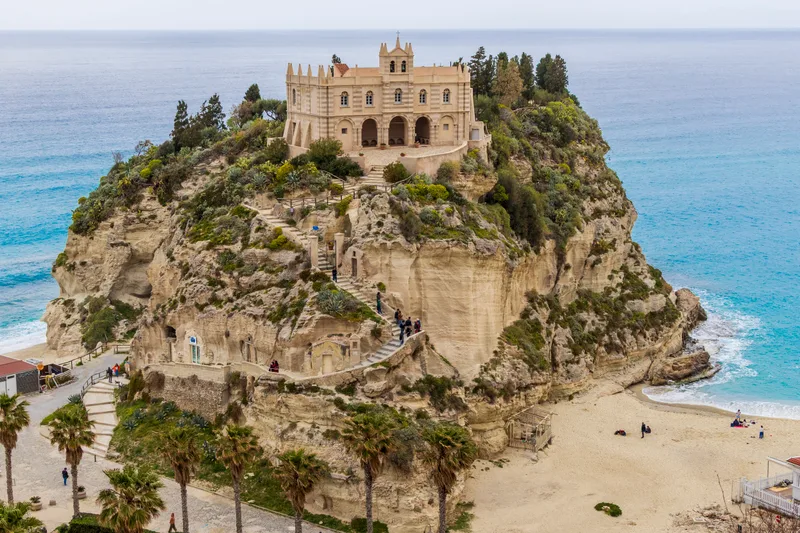
Traces of that world survive. The walls are still called the mura di Belisario, after the Byzantine general Belisarius. Hermits and Byzantine monks lived on the rock of Santa Maria dell'Isola in Tropea, and the town's Greek-rite cathedral of San Nicola stood where the Chiesa del Gesù now stands, until it was pulled down in 1594. The Byzantine centuries were not peaceful: at one point Arab raiders took the town after a long siege.
How did the Normans change Tropea?
They turned it Latin and gave it a cathedral. Around 1060, under the Norman duke Robert Guiscard, the church on the island rock switched from the Greek to the Latin rite and passed to the Benedictines, who later ranked it among the possessions of Montecassino. A Greek-rite bishop, Kalochinus, is still recorded in 1066, but by 1094 Justego had become the first Latin bishop of Tropea.
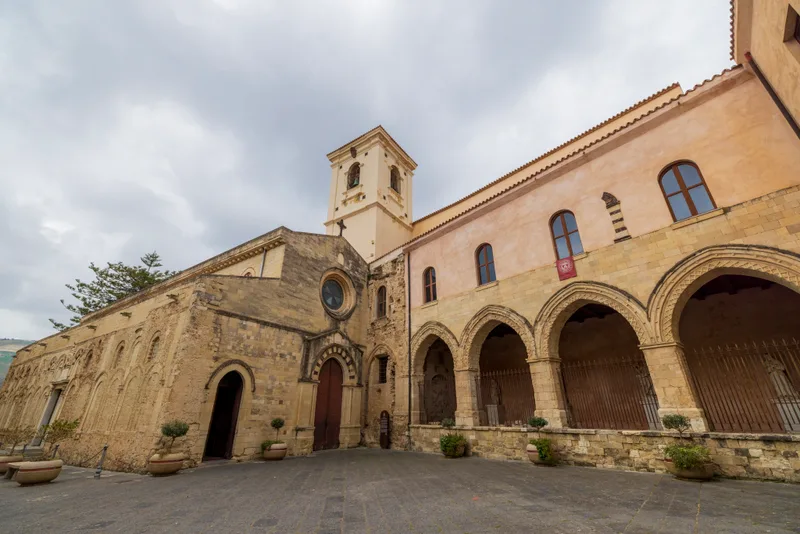
In 1094, Roger, Duke of Apulia and Calabria, confirmed the possessions the Greek bishops had held, and in 1179 Pope Alexander III confirmed the rights of the Church of Tropea. The cathedral, now the co-cathedral of Tropea Cathedral and the Madonna di Romania, went up in the 12th century in yellowish tuff and lava stone.
Where do Tropea's noble palaces come from?
Mostly from the 17th and 18th centuries, built by the noble families of a town that prized its status as a royal possession rather than a feudal one. Tropea prospered under the Aragonese and then the Spanish crown, and its churches chart the period: the Annunziata from 1521, under Charles V, San Francesco di Paola from 1552 and the Carmine from 1569.
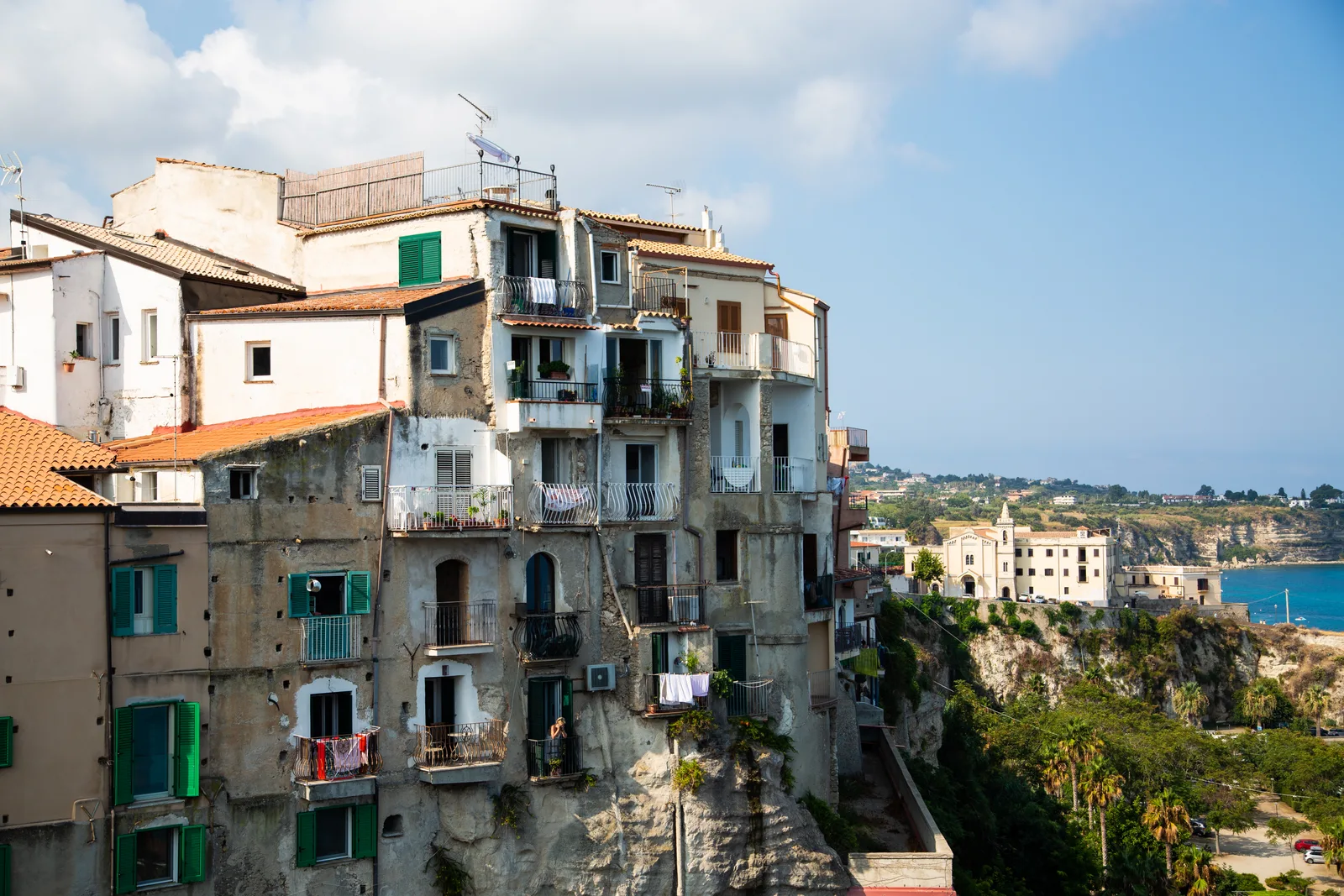
In the 17th century Tropea was sold, illegitimately. Nobles, clergy, merchants, common people and women joined forces to overturn the sale, and in 1615 the King of Spain returned the town to the royal domain, citing its "renowned antiquity, beauty and nobility". The carved portals of the palaces on the cliff carried each family's identity, the portal of Palazzo Bragho is dated 1721, and some palaces have cisterns cut into the rock to store grain from Monte Poro. The noble palaces of Tropea page walks through them.
How did earthquakes, plague and war shape the town?
They destroyed a great deal, and they made the cult of the Madonna di Romania. Tropea credits its patron with sparing it in the earthquake of 27 March 1638 and in the plague of 1660, and it still celebrates her main feast on that March date. The earthquake of 1783 left the cathedral severely damaged; the quakes of 1905 and 1908 struck again, and the 1905 shock brought down part of Santa Maria dell'Isola, which was rebuilt with the facade you see today.
The 20th century added its own story. In the 1920s the Lumia stream was diverted through a tunnel to build the port. In September 1943 American aircraft dropped six bombs on the town and not one exploded; two are displayed in the cathedral. Two figures buried in its cathedral shaped the town's sense of itself: the Tropea-born philosopher Pasquale Galluppi, who lived into the 19th century, and Francesco Mottola, founder of the periodical Parva Favilla in 1933 and beatified in 2021.
What is Tropea like today?
A small town of around 5,800 residents on a rock about 60 meters above the Tyrrhenian, smaller than its peak of 6,953 in the 1951 census. In 1986 its ancient diocese was merged into that of Mileto-Nicotera-Tropea. In 2021 it won the Borgo dei Borghi, the national vote for Italy's favorite village, and its red onion, grown along this coast, carries the town's name; see Tropea red onion.
To see this history on the ground, follow the walking route through Tropea old town, and for the wider region's past, the history of Calabria.
Planning Calabria?
Hear when 2027 dates open
A small group of women, one week in Tropea, everything arranged. Join the list for first word on dates and an occasional letter from Calabria.
One email when 2027 dates open, and an occasional letter from Calabria. Unsubscribe any time.
Questions
How old is Tropea?
The site was used in Roman times, when a port operated near Santa Domenica, and a bishop of Tropea is documented in 649. The medieval town grew up under Byzantine and then Norman rule, and most of the palaces you see are from the 17th and 18th centuries.
Was Tropea ever ruled by Spain?
Yes, as part of the Kingdom of Naples under the Spanish crown. In 1615 the King of Spain returned Tropea to the royal domain after the town fought an illegitimate sale.
Why is Santa Maria dell'Isola linked to Montecassino?
The Benedictines took over the church after the Normans brought it into the Latin rite around 1060, and it appears among Montecassino's possessions on the abbey's bronze door. The abbey still owns it.
What does Borgo dei Borghi mean?
It means village of villages, the title of a national contest for Italy's favorite small town. Tropea won it in 2021.
Sources and further reading
- Wikipedia (Italian): Tropea
- Wikipedia: Roman Catholic Diocese of Tropea
- Tropea Tourism: Dario Godano on Tropea, città libera
- Tropea Tourism: the solemnity of the Madonna di Romania
- Comune di Tropea
Checked November 19, 2026. Timetables, prices and opening hours change; confirm before you travel.
Keep reading
Related guides