Costa degli Dei guide
Capo Vaticano travel guide
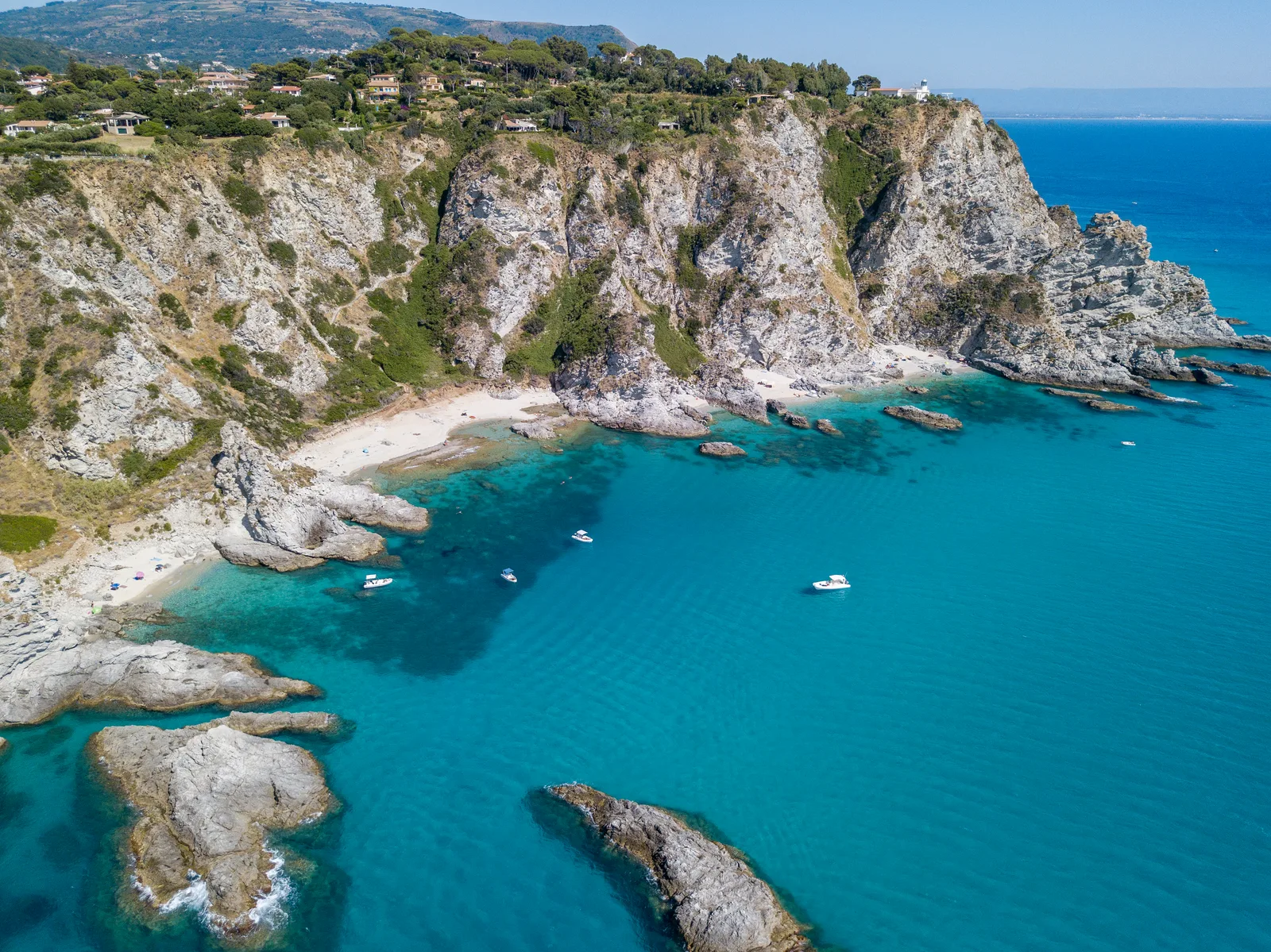
Capo Vaticano is the granite headland about 20 to 25 minutes' drive south of Tropea, in the comune of Ricadi, where the Costa degli Dei turns between the Gulf of Sant'Eufemia and the Gulf of Gioia Tauro. Go for the coves at its feet, such as Grotticelle, Tono and Formicoli, and for the lighthouse viewpoint about 100 meters above the sea, which looks toward the Strait of Messina and the Aeolian Islands. Half a day covers the headland; a beach day fills the rest.
Where is Capo Vaticano, and how do you get there from Tropea?
It is the next headland south of Tropea, about 13 km away by road, and the drive takes 20 to 25 minutes. The cape belongs to the frazione of San Nicolò, in the comune of Ricadi, whose scattered villages were satellites of Tropea until 1799. It marks the point where the Gulf of Sant'Eufemia ends and the Gulf of Gioia Tauro begins.
A car or driver is the practical way to go, since the beaches and the lighthouse are spread out across the promontory. You can also see the whole headland from the water: boats bound for the Aeolian Islands sail past it, and seeing this coast from the water is the idea behind a sailing day on the Costa degli Dei.
What is there to see on the headland itself?
The lighthouse and the view from beside it. The promontory is built of a distinctive white-grey granite, studied by geologists for its characteristics, and rises to a maximum of about 124 meters. The lighthouse stands at the tip, about 100 meters above the sea. From the belvedere near it you look over the Gulf of Gioia Tauro toward the Strait of Messina, and out to the Aeolian Islands.
The view is best late in the day, when the sea changes color at sunset and, on clear evenings, the islands sharpen on the horizon. A small sea museum is housed in a former coastguard lookout post on the cape; check locally whether it is open before you plan around it.
Which Capo Vaticano beach should you choose?
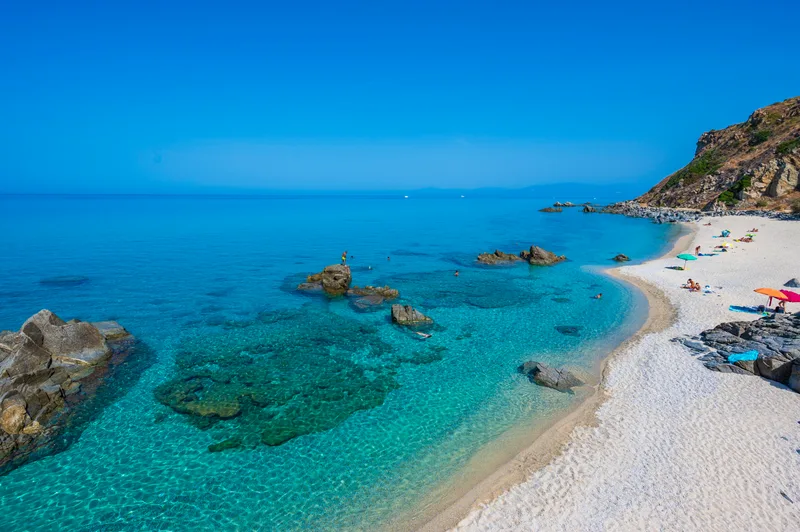
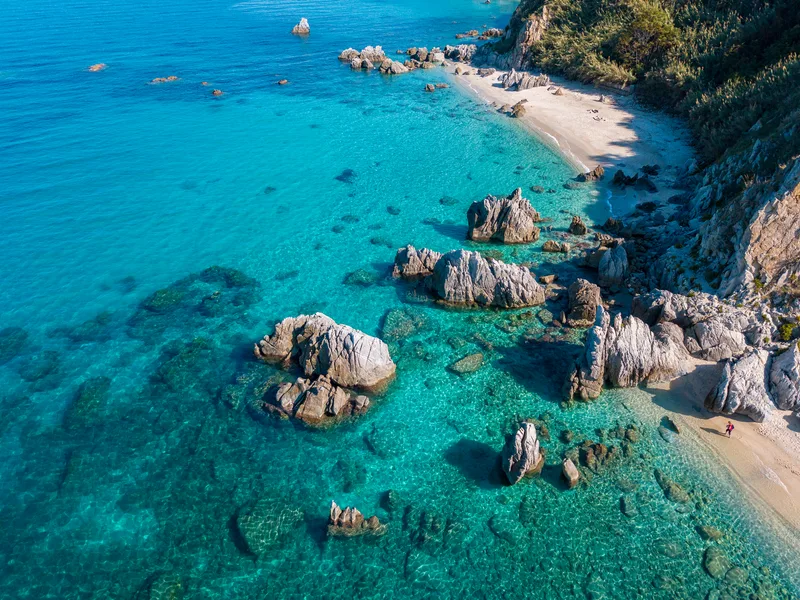
Pick by what you want in the water. The coves around the cape mix fine white sand with granite rocks, and the rocks make the snorkeling.
- Details on the most photographed cove: Grotticelle beach at Capo Vaticano.
- Every beach in the comune, with access notes: Ricadi beaches guide.
- Where to put your mask in: snorkeling on the Costa degli Dei.
| Beach | What it is like | Good for |
|---|---|---|
| Grotticelle | Fine white sand | A classic beach day; see its own guide |
| Tono | Fine white sand | Swimming and lounging |
| Santa Maria and Tonicello | The two ends of the cape's coastline | Walking and exploring the whole stretch |
| Formicoli | Seabed of granite boulders rich in sea life | Snorkeling |
| Baia di Riaci | Fine white sand, between the cape and Tropea | A shorter drive from Tropea |
| Torre Marino | A beach named for its coastal tower | Combining a swim with the towers |
Why is it called Capo Vaticano?
Because of a prophecy. In the Greek period the headland was known as the Taurianum Promontorium, and tradition says it held an oracle that sailors consulted before risking the Strait of Messina, home in myth to Scylla and Charybdis. The Roman-era name comes from the Latin vaticinium, a prediction.
The cape also has a modern literary owner. The Venetian writer Giuseppe Berto, whose novel Il male oscuro won both the Viareggio and the Campiello prizes in 1964, made Capo Vaticano his home and is buried in the cemetery of San Nicolò. A literary prize in his name, for young writers, is held every June.
What history is there around Ricadi beyond the beaches?
Coastal towers, a Roman harbor and onions. A chain of watchtowers once guarded this shore against raiders: Torre Santa Maria, Torre Tono, Torre Ruffa, Torre Marino and Torre Marrana. Torre Marrana now holds a small Museo delle torri inside an archaeological park, drawing on a 16th-century manuscript, the Codice Romano Carratelli, that drew the towers of Calabria's coast.
Near Formicoli, in Santa Domenica di Ricadi, lie the partly submerged remains of the Portus Herculis, the Roman port linked to Tropea's earliest history. And the cape itself was where the famous red onions were grown before being carried to Tropea to be sold; the Tropea red onion page tells that story.
How should you plan a day at Capo Vaticano?
Swim in the morning, rest at midday and finish at the lighthouse for sunset. Arrive at the beach early in summer, when the coves fill up, and keep the belvedere for the last hour of light. If you only have an evening, drive straight to the lighthouse and pair it with dinner back in Tropea.
For other half-day escapes from Tropea, compare Capo Vaticano with Pizzo in the guide to day trips from Tropea, and for the town's own sand, see the best beaches in Tropea.
Planning Calabria?
Hear when 2027 dates open
A small group of women, one week in Tropea, everything arranged. Join the list for first word on dates and an occasional letter from Calabria.
One email when 2027 dates open, and an occasional letter from Calabria. Unsubscribe any time.
Questions
How far is Capo Vaticano from Tropea?
About 13 km by road, a drive of 20 to 25 minutes. It is the next headland south of Tropea, in the comune of Ricadi.
Can you see Stromboli from Capo Vaticano?
Yes, on clear days. The lighthouse viewpoint looks out to the Aeolian Islands, and Stromboli's cone is the one to look for. Haze can hide the islands completely.
Is Capo Vaticano good for snorkeling?
Yes. Formicoli in particular has a seabed of granite boulders rich in sea life, which makes it the pick for a mask and snorkel.
Is Capo Vaticano a town or just a beach area?
It is a headland and holiday area within the frazione of San Nicolò, part of the comune of Ricadi, rather than a town with a historic center. It has plenty of holiday accommodation; for an old town, Tropea is the nearest.
Sources and further reading
- Wikipedia (Italian): Capo Vaticano
- Wikipedia (Italian): Ricadi
- Wikipedia: Capo Vaticano
- Wikipedia: Giuseppe Berto
Checked November 19, 2026. Timetables, prices and opening hours change; confirm before you travel.
Keep reading
Related guides