Calabrian food guide
Tropea red onion
The Tropea red onion is a sweet, mild red onion grown on the Tyrrhenian coast of Calabria and protected since 2008 as Cipolla Rossa di Tropea Calabria IGP. Only 23 coastal towns, from Fiumefreddo Bruzio south to Nicotera, may grow it, and it is sold in three types: the spring-onion style cipollotto, the fresh onion and the storage onion braided for keeping. Eat it raw in a tomato salad, with tuna, or slow-cooked into sweet-and-sour preserves.
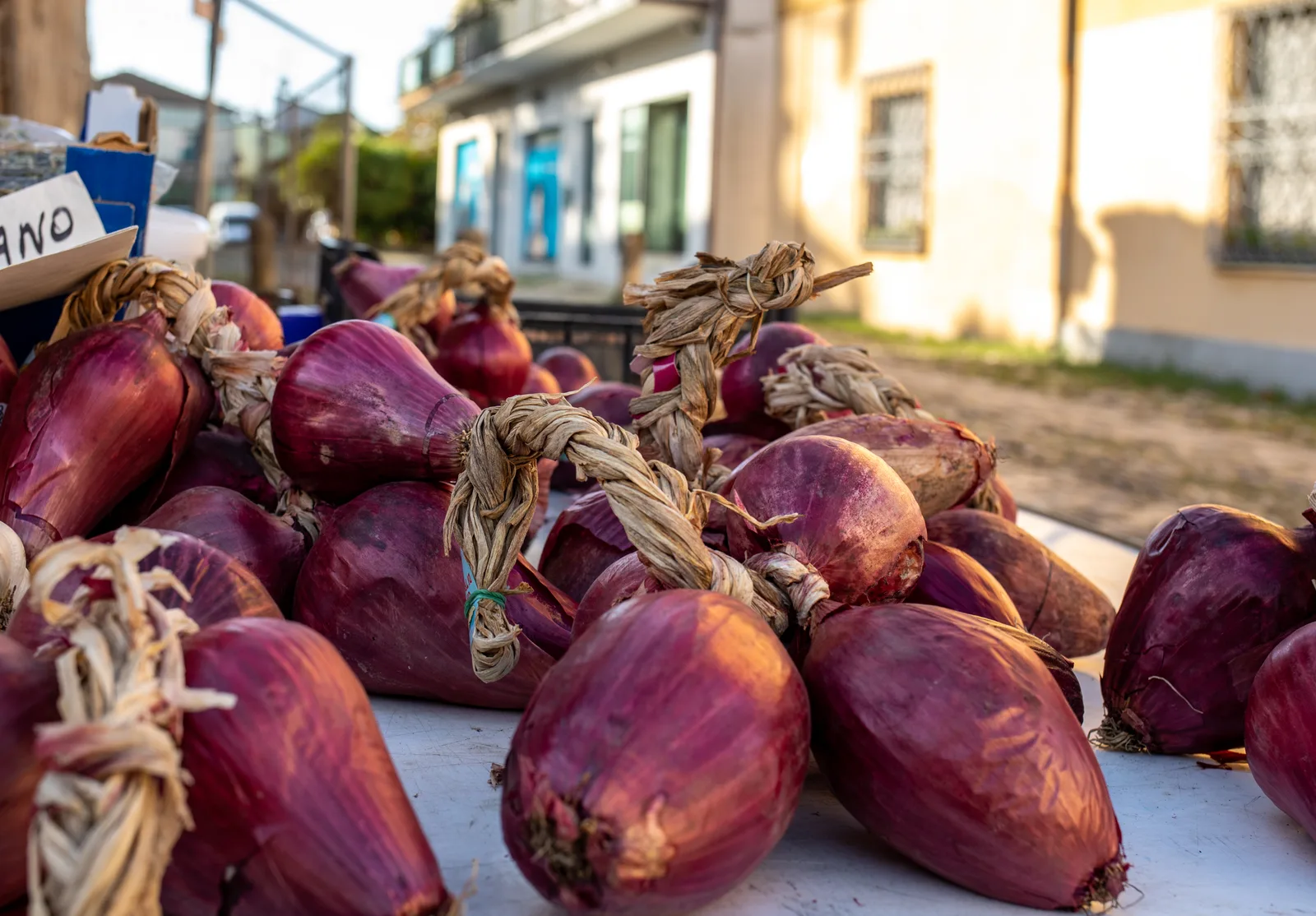
Three types of Tropea onion, and how to tell them apart
The IGP recognizes three types, and the label must say which one you are buying. They differ mainly in how mature the onion is when it is pulled, and so in how long it keeps. The rules also name three local shapes, tied to how early the bulb forms: Tondo Piatta (round and flat, earliest), Mezza Campana (half-bell, mid-season) and Allungata (elongated, latest).
| Type | Color and texture | How it is sold | How long it keeps |
|---|---|---|---|
| Cipollotto | White, pink and violet; sweet and tender | With long green stalks, 30 to 60 cm | A few days |
| Cipolla da consumo fresco | White-red shading to violet; sweet and tender | In bunches of 1.5 to 6 kg, stalks trimmed | A few days |
| Cipolla da serbo | Deep red-violet; sweet and crunchy | Field-dried, in braids or mesh bags | A little over a month in a braid |
Only 23 towns on one stretch of coast may grow it
The protected area is a coastal band across three provinces, from Fiumefreddo Bruzio and Amantea in Cosenza province, through Lamezia Terme in Catanzaro, to Tropea, Ricadi and Nicotera in Vibo Valentia. The EU registered the name in March 2008 and amended the rules in 2013. A consortium based in Vibo Valentia promotes it, and the certification body CSQA checks producers.
Within those towns, only listed plots of sandy or loamy soil qualify. That explains the fields of onions you pass around Ricadi and Capo Vaticano, close to Tropea itself. It is a real crop, not a souvenir: about 18 million kilograms came from 115 certified operators in 2023.
Why it tastes sweet rather than sharp
The sweetness is attributed to a mix of local strains, mild coastal winters and light alluvial soils. The EU specification describes the fresh types as sweet and tender and the storage onion as sweet and crunchy, without the harsh bite of a standard red onion. The consortium credits sun and sea, which keep winters mild and steady.
In practice it means you can eat it raw in quantities that would overpower you with an ordinary onion. Slice it thin and let it sit in the dressing for a few minutes before eating.
How to eat Tropea onion, and what to order
Order it raw first. The classic Calabrian salad is sliced Tropea onion with tomato, extra virgin olive oil, salt and oregano. Its other great partner is tuna, a pairing the regional agriculture agency singles out.
- Insalata di pomodoro e cipolla: tomato, onion, oil, oregano. Mop it up with bread.
- With tuna: raw onion over tuna preserved in oil, a natural match on a coast with a long tuna-fishing past.
- In pasta: look for pasta alla tropeana, or fileja tossed with slow-cooked red onion.
- Agrodolce and caramelized: whole onions or rings cooked sweet-and-sour, served as a side or antipasto.
- Preserved: onions in oil, creams and jams. To make one at home, try the Tropea red onion jam recipe.
Which onions you find in September and October
In early autumn you mostly find braided storage onions from the summer harvest, with fresh onions starting again from October. The early, mid and late shapes are harvested between mid-April and the end of July. Onions planted in late August come in from October, and transplanted crops supply the markets from about December to March.
Ricadi has held a Sagra della Cipolla Rossa in mid-August since the late 1970s, but it falls before an autumn trip. The Tropea red onion festival page covers it.
How to spot the real thing and take some home
Look for the words "IGP Cipolla Rossa di Tropea Calabria" printed larger than anything else on the label, plus the type. The rules require that name at twice the size of other text. A red onion without it, however it is displayed, is just a red onion. Braids must hold at least six onions.
- Braids: buy only if you will cook with them within the month. They hang well in a kitchen but do not travel.
- Fresh onions: plan to eat them within days.
- For home: fresh vegetables face strict agricultural rules at US customs, so pack sealed jars of agrodolce onions or onion jam instead. See Calabrian food souvenirs to bring home and can you bring Italian food back to the US.
Planning Calabria?
Hear when 2027 dates open
A small group of women, one week in Tropea, everything arranged. Join the list for first word on dates and an occasional letter from Calabria.
One email when 2027 dates open, and an occasional letter from Calabria. Unsubscribe any time.
Questions
Is a Tropea onion the same as a red onion?
It is a red onion, but a distinct local one. Only onions grown in the 23 listed towns under the IGP rules may carry the name, and they are noticeably sweeter and milder than a standard supermarket red onion.
Can you eat Tropea onion raw?
Yes, and that is the best way to taste it. Thin slices with tomato, olive oil, salt and oregano are the classic Calabrian salad.
Are Tropea onions grown in Tropea itself?
Tropea is one of 23 towns in the protected area, which runs along the coast from Fiumefreddo Bruzio to Nicotera. Many fields lie around Ricadi and Capo Vaticano, just south of the town.
What can I use instead of Tropea onion at home?
A mild red onion or a sweet onion is the closest swap. Soak the slices in cold water for ten minutes to soften the bite before adding them to a salad.
Sources and further reading
- Commission Implementing Regulation (EU) No 264/2013, Cipolla Rossa di Tropea Calabria (PGI)
- Qualigeo: Cipolla Rossa di Tropea Calabria IGP
- Consorzio di Tutela Cipolla Rossa di Tropea Calabria IGP
- Regione Calabria and ARSAC: DOP, IGP and PAT products of Calabria (2023)
- Google Arts & Culture (Italian Ministry of Agriculture): Cipolla Rossa di Tropea Calabria
Checked November 19, 2026. Timetables, prices and opening hours change; confirm before you travel.
Keep reading
Related guides