Museum guide
Riace Bronzes at the Reggio Calabria museum
The Riace Bronzes are two life-size Greek bronze warriors from the 5th century BC, found in shallow water off Riace Marina on 16 August 1972 and kept since 1981 at the Museo Archeologico Nazionale di Reggio Calabria (MArRC). They stand in a climate-controlled room that visitors enter in small groups. The museum usually opens Tuesday to Sunday, 9 a.m. to 8 p.m., and a full ticket costs about €8 to €10, so check the official site before you go. From Tropea, plan a full day.
A holiday diver found them off Riace Marina in August 1972
On 16 August 1972, Stefano Mariottini, a diver on holiday, saw what he later described as a dark shoulder projecting from the sand off Riace Marina, on Calabria's Ionian coast. The two statues lay a few hundred meters offshore in shallow water. Accounts differ on the details: the official report put them about 300 meters out and 10 meters down, while Mariottini's own 2009 account gives about 6 meters.
Even the question of who found them first is still argued over, and nobody knows how two masterpieces came to rest on that seabed. That uncertainty is part of why the find made headlines across Italy and still draws people to a museum at the far southern tip of the peninsula.
What to look for on Statue A and Statue B
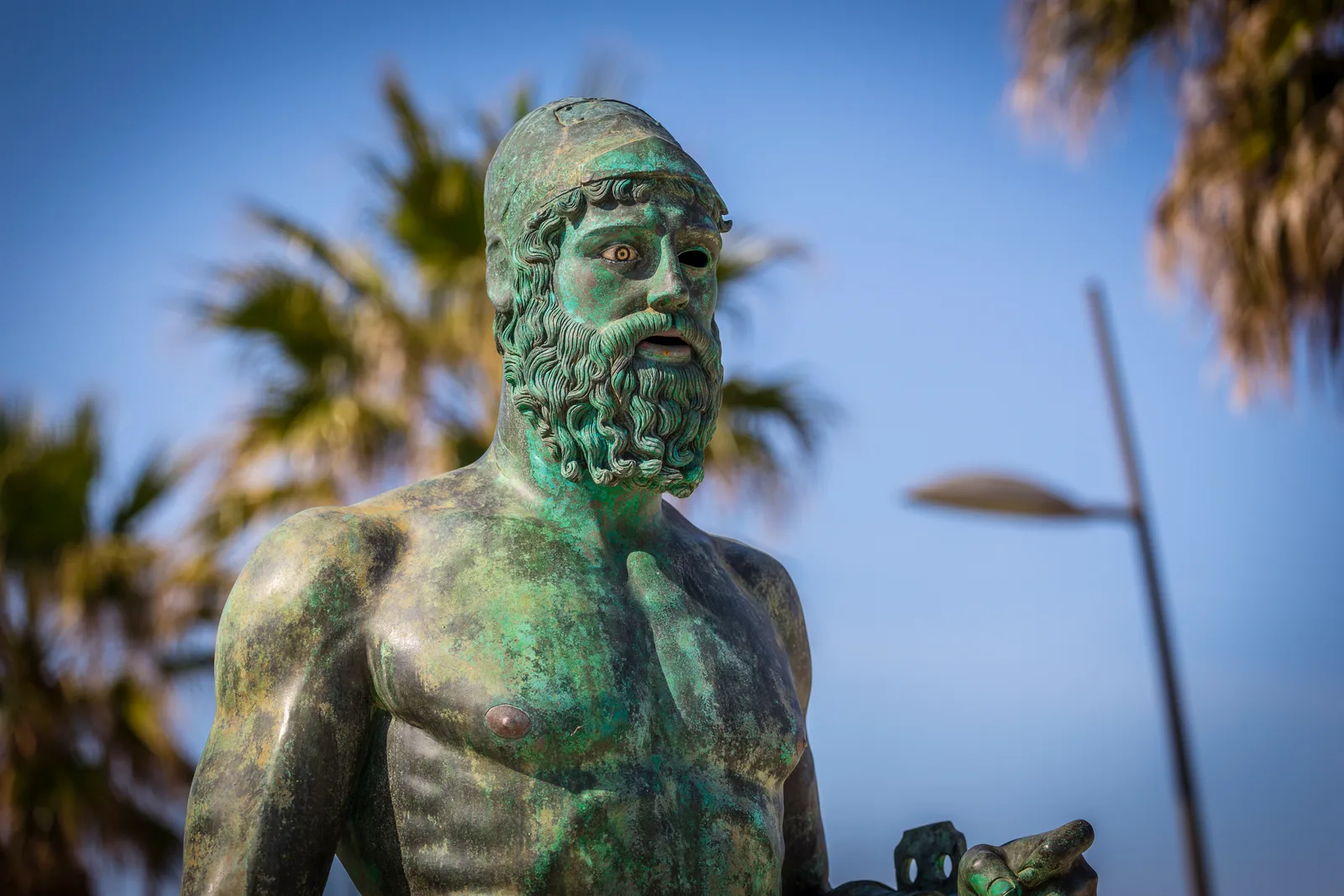
The bronzes are two nude, bearded warriors a little taller than life, known simply as Statue A and Statue B. Scholars usually date Statue A to around 460 BC and Statue B to around 430 BC, although radiocarbon tests in 2012 gave results that overlap almost entirely and could not confirm the thirty-year gap.
Get close to the faces. The lips, eyelashes and nipples are inlaid in copper, which reads redder than the bronze around it. The eyes are set with white calcite and glass paste, which is why they seem to follow you. Statue A still shows a row of silver teeth between its parted lips.
| Statue A | Statue B | |
|---|---|---|
| Height | About 1.98 m | About 1.97 m |
| Usual dating | Around 460 BC | Around 430 BC |
| Detail to find | Silver teeth visible between the lips | Shows elements of the Polykleitan tradition |
| Shared inlays | Copper lips, lashes and nipples; calcite and glass eyes | Copper lips, lashes and nipples; calcite and glass eyes |
Nobody agrees on who made them or who they portray
There is no consensus on the sculptor, the subjects or where the statues first stood. Names put forward include Phidias, linked by some to an Athenian dedication at Delphi; Myron; Alcamenes; Onatas; and Pythagoras of Rhegion, a sculptor from Reggio itself. Statue B shows elements of the tradition of Polykleitos, which does not prove he made it.
The archaeologist Paolo Moreno proposed in 1998 that they are Tydeus and Amphiaraus, two of the Seven Against Thebes, from a group set up at Argos. Others have suggested Athenian heroes, athletes or the boxer Euthymos of Locri. For a visitor the open question is part of the pull: you are standing in front of two of the very few large Greek bronzes to survive, and no label can tell you who they were.
Fifty years of restoration, travel and return
The bronzes came out of the sea encrusted and still holding much of the clay core used to cast them, and they have been restored several times since. Their fame grew with each trip, and their current bases are part of the story: platforms of Carrara marble designed by the Italian agency ENEA to isolate them from earthquakes, the first anti-seismic bases of their type.
| When | What happened |
|---|---|
| 16 August 1972 | Found off Riace Marina |
| 1975 to 1980 | Restored in Florence by Renzo Giachetti and Edilberto Formigli |
| 15 December 1980 | First shown to the public at Florence's National Archaeological Museum |
| 29 June to 12 July 1981 | Displayed at the Quirinal Palace in Rome, then installed in Reggio |
| 1992 to 1995 | Second restoration removes the remaining casting core |
| 2009 to 2013 | Restored again at Palazzo Campanella in Reggio; back in the museum on 21 December 2013 |
| 30 April 2016 | The renovated museum reopens in full |
Hours, tickets and how the bronzes room works
The museum is at Piazza De Nava 26 in central Reggio, and its regular pattern is Tuesday to Sunday, 9 a.m. to 8 p.m., with last entry at 7:30 p.m. and Mondays closed apart from announced holiday openings such as Easter Monday. The full ticket was €8 for years and rose to €10 from July 2024; visitors aged 18 to 25 pay €2 and under-18s go free. Tickets are handled by CoopCulture and booking is optional.
Since 2025 an integrated ticket, the CalabriaCulturaPass, has linked the museum with smaller state sites such as the archaeological park at Bova Marina and the Metauros and Medma museums, valid for six months from first use. Prices, hours and extra openings change through the year, so confirm them on the official MArRC opening hours page before you set out.
The bronzes room has its own air control and filtration, and visitors go in in groups of about twenty, so expect a short wait on busy days.
| Item | What to expect |
|---|---|
| Open | Tuesday to Sunday, 9 a.m. to 8 p.m. |
| Last entry | 7:30 p.m. |
| Closed | Mondays, except announced special openings |
| Full ticket | About €8 to €10 (€10 since July 2024) |
| Reduced and free | €2 for ages 18 to 25; free under 18 |
| Time needed | 20 to 30 minutes in the bronzes room; 2 to 3 hours for the museum |
| From Tropea by car | About 1 h 30 min to 1 h 45 min each way |
Give the rest of the museum another hour
The bronzes share the building with the finest collection of Greek finds from Calabria, and several pieces are worth seeking out.
- The Philosopher: a bronze head from a shipwreck found in 1969 near Villa San Giovanni, dated to the second half of the 5th century BC and a rare example of Greek portraiture. A second head from the same wreck, known as the Basel head, is also in the museum.
- The Dioscuri of Locri: a marble group of the twin horsemen, about 420 to 380 BC, from the Ionic temple at Locri.
- The pinakes: painted terracotta votive plaques, mostly from Locri, offered to Persephone between about 490 and 450 BC.
- The Kouros of Reggio: a marble statue of a nude youth in Parian marble, from the 6th century BC.
- The building: Palazzo Piacentini, built between 1932 and 1941 to Marcello Piacentini's design, with a modern extension by Paolo Desideri.
Planning Calabria?
Hear when 2027 dates open
A small group of women, one week in Tropea, everything arranged. Join the list for first word on dates and an occasional letter from Calabria.
One email when 2027 dates open, and an occasional letter from Calabria. Unsubscribe any time.
Questions
How long do you need to see the Riace Bronzes?
Twenty to thirty minutes in the bronzes room is enough to walk around both statues slowly. Most visitors spend two to three hours in the whole museum, which also holds the Philosopher head and the finds from Locri.
Are the Riace Bronzes the original statues?
Yes. They are the original Greek bronzes raised in 1972. They have been restored several times, most recently from 2009 to 2013 at Palazzo Campanella in Reggio, and have been displayed in Reggio since 1981.
Is the Reggio Calabria museum open on Mondays?
Usually not. The regular pattern is Tuesday to Sunday, with occasional Monday openings for holidays such as Easter Monday or major national holidays. These are announced on the museum's own site and on the Ministry of Culture's events pages.
Why are the Riace Bronzes in Reggio and not in Riace?
Riace Marina, where they surfaced, lies on the Ionian coast in the Metropolitan City of Reggio Calabria, and the statues belong to the national museum in Reggio, which holds the major Greek finds of the area. There is nothing of the find to see at Riace itself.
Sources and further reading
- Wikipedia: Riace bronzes
- MArRC: Opening hours, ticket prices and visitor info
- Ministero della Cultura: MArRC Museo archeologico nazionale di Reggio Calabria
- Wikipedia (Italian): Museo archeologico nazionale di Reggio Calabria
- Finestre sull'Arte: Calabria single ticket for museums and sites (2025)
Checked November 19, 2026. Timetables, prices and opening hours change; confirm before you travel.
Keep reading
Related guides