Calabrian culture
Calabrian culture and traditions
Calabrian culture is layered: Greek colonists, Byzantine monks, Normans, Swabians and the Kingdom of Naples all left their mark, and three minority languages, Arbëresh Albanian, Griko and Occitan, survive in its villages. Its living traditions are religious and communal: the Easter Affruntata, the UNESCO-listed Varia of Palmi, devotion to Saint Francis of Paola, the tarantella danced in a ring, and a kitchen built on preserving the harvest in oil, salt and chili.
Three minority languages are still spoken
Calabria is home to three historic linguistic minorities, protected as such by Italian law. Each community arrived for a different reason, and each gives its villages a sound and character of their own.
- Arbëreshë: in 1448 King Alfonso of Aragon settled soldiers of the Albanian hero Skanderbeg in villages of Calabria, and more refugees followed. The communities keep the Byzantine rite under the Eparchy of Lungro, dance their traditional vallje, and their language is protected by Italian law 482 of 1999. Civita has a statue of Skanderbeg.
- Grecanici: Griko is listed in UNESCO's Red Book of endangered languages and is still heard in about nine towns of the Bovesìa.
- Occitans: Guardia Piemontese's main gate is called the Porta del Sangue, the Gate of Blood, in memory of June 1561, when about 2,000 Waldensians were killed in the town and nearby places.
| Community | Language | Where | Roots |
|---|---|---|---|
| Arbëreshë | Arbëresh Albanian | Civita, Lungro, San Martino di Finita and dozens of villages, mostly in Cosenza province | Refugees from the Ottoman advance, from the 15th century |
| Grecanici | Griko, the Greek of Calabria | Bova, Roghudi, Gallicianò and other towns of the Bovesìa in Aspromonte | Greek-speaking communities of the far south; about 2,000 speakers in 2010 |
| Occitans | Occitan | Guardia Piemontese, in Cosenza province | Waldensian settlers of the 12th and 13th centuries |
Easter and the saints bring traditions into the street
Religious feasts are where Calabrian tradition is most visible, and Easter is the high point. The Affruntata, or Cunfrunta, re-enacts the meeting of the risen Christ with his mother. On Easter Sunday, or in some towns a day or a week later, bearers run the statue of Saint John back and forth between Christ and the Madonna three or five times, ever faster, as the messenger of the resurrection. Then the Madonna is rushed to meet her son, her black mourning veil falls away and a festive dress, often blue or white, appears beneath. The rite is strongest in the provinces of Vibo Valentia and Reggio Calabria, in towns such as Vibo Valentia, Soriano Calabro, Sant'Onofrio, Stefanaconi and Pizzo. See Easter in Calabria and the Affruntata.
In Palmi, bearers carry the Varia, a towering structure representing the universe and the Assumption of the Virgin, in honor of Our Lady of the Holy Letter. In 2013 UNESCO inscribed it on its list of Intangible Cultural Heritage, together with the shoulder-borne processions of Nola, Sassari and Viterbo. Dates vary, so check the Calabria festivals and events calendar.
In Greek-speaking Bova, Palm Sunday brings the procession of the Persephoni, whose name recalls the Greek goddess Persephone.
Saint Francis of Paola is Calabria's own saint
Calabria's patron saint is Francis of Paola, born in the Tyrrhenian town of Paola on 27 March 1416. He founded the Order of Minims, whose name means the least of the faithful, and died in 1507; his feast day is 2 April.
His best-known legend ties him to the sea. In 1464, refused passage to Sicily by a boatman, he is said to have spread his cloak on the water, tied one end to his staff as a sail and crossed the Strait of Messina. Pope Pius XII named him patron of Italy's seafarers in 1943, and Pope John XXIII made him patron of Calabria in 1963.
Music and dance: the tarantella in a ring
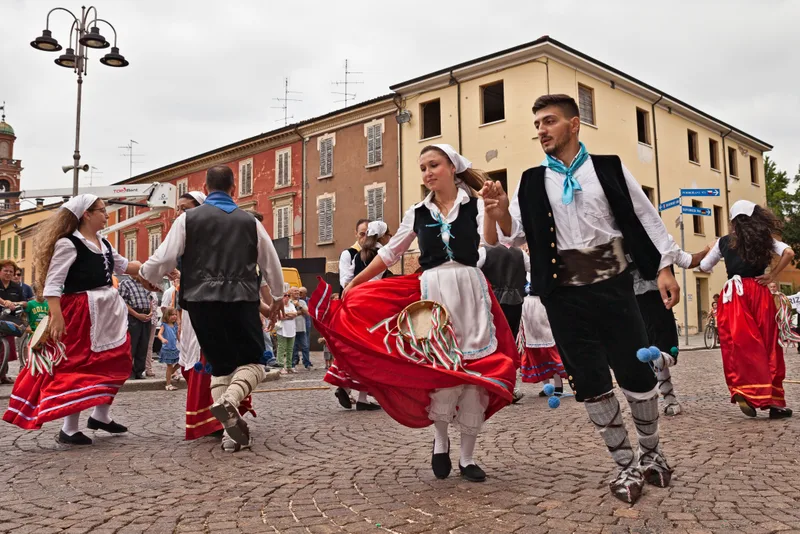
The Calabrian tarantella, called sonu a ballu in the region, is danced by couples inside a circle called the rota, the wheel. A master of the dance, u mastru i ballu, decides who enters and when, and the musicians watch the dancers and follow their pace rather than the other way round.
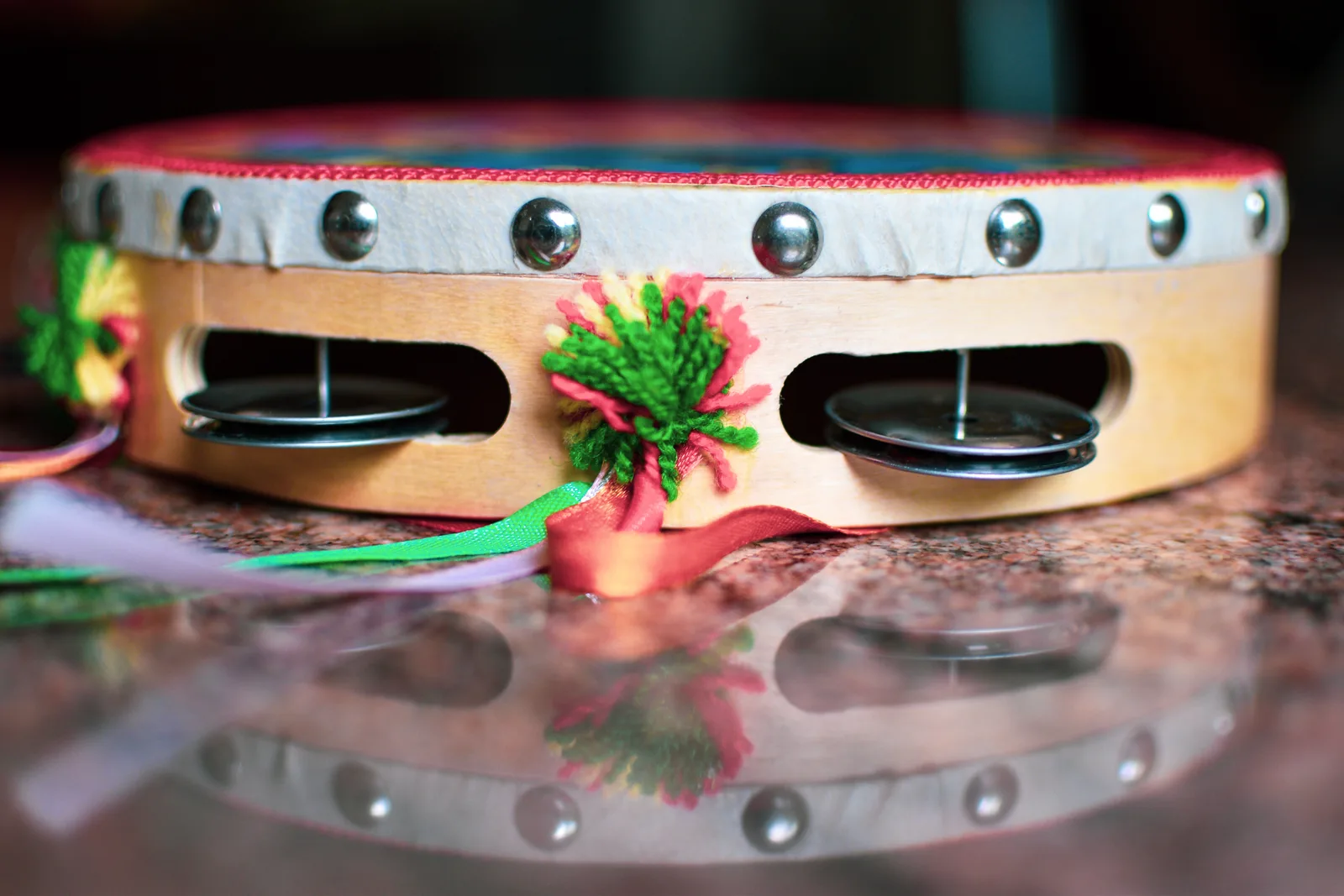
The classic sound is the zampogna, a bagpipe, often replaced today by the organetto, a button accordion, over the beat of a tamburello. In the Locride and on Monte Poro, near Tropea, you may also hear the Calabrian lira, a bowed instrument with three strings played upright on the knee. The tradition lives at religious feasts and village gatherings, and has seen a revival in recent years.
Food traditions are about keeping the harvest
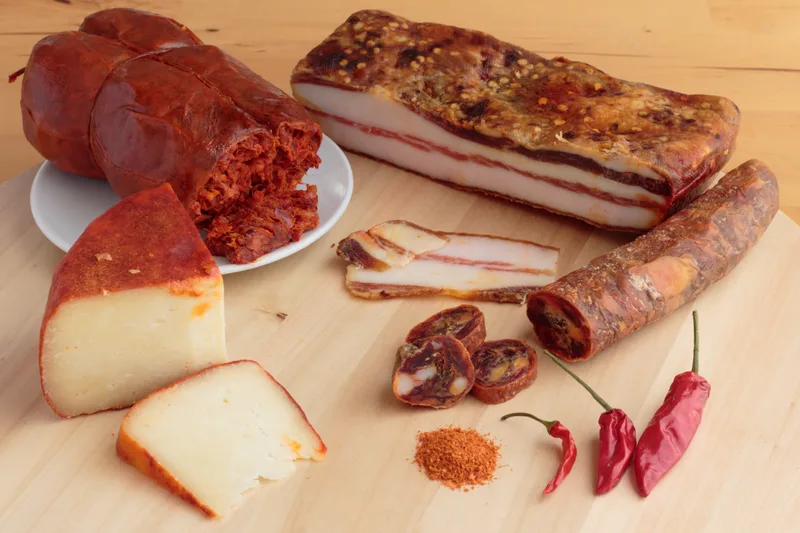
Calabrian cooking grew out of preserving: vegetables packed in olive oil, pork turned into soppressata, capocollo and the spreadable, chili-hot 'nduja, and fish cured on the coast, especially swordfish, sardines and salt cod. Caciocavallo cheese, the red onion of Tropea and liquorice are regional emblems.
Wine is older still. In ancient times this land was called Enotria, the land of wine, and Cirò and Donnici are its best-known DOC wines today. Start with what to eat in Calabria and what is 'nduja.
Ancient layers you can still see
History here is visible, not abstract. Greek Sybaris, founded around 720 BC, gave English the word sybarite. Locri, founded around 680 BC, is credited with the first written Greek law code, by the lawgiver Zaleucus. Pythagoras founded his school at Croton around 530 BC.
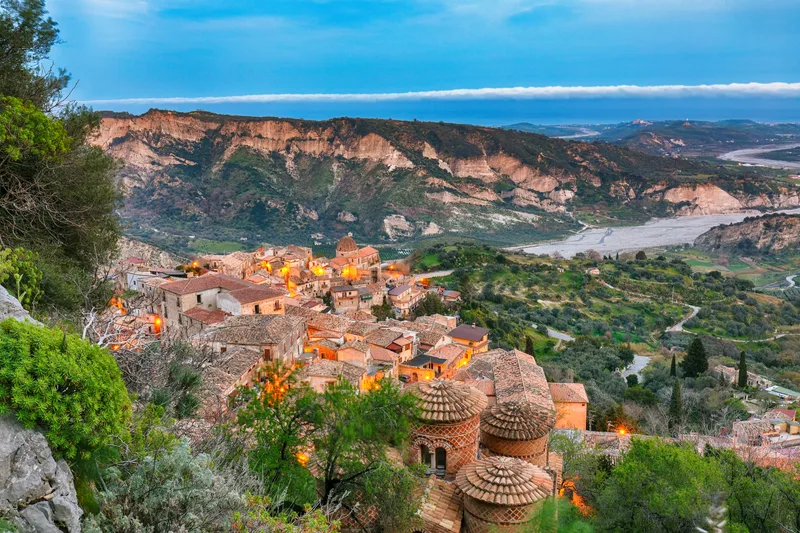
The Byzantine centuries left the 6th-century Codex Purpureus Rossanensis, now on UNESCO's Memory of the World register, and small domed churches such as Stilo's Cattolica. The Normans took Gerace in 1059, Frederick II restored Cosenza's castle in 1239, and Cosenza's Accademia Cosentina, one of the oldest academies in Europe, counted the philosopher Bernardino Telesio among its members. For the sites, see Magna Graecia sites in Calabria and the most beautiful villages in Calabria.
Planning Calabria?
Hear when 2027 dates open
A small group of women, one week in Tropea, everything arranged. Join the list for first word on dates and an occasional letter from Calabria.
One email when 2027 dates open, and an occasional letter from Calabria. Unsubscribe any time.
Questions
What languages are spoken in Calabria?
Italian everywhere, alongside Calabrian dialects that vary from province to province. In some villages you will also hear Arbëresh Albanian, mostly in Cosenza province, Griko in the Bovesìa of Aspromonte, and Occitan at Guardia Piemontese.
Who is the patron saint of Calabria?
Saint Francis of Paola, born in Paola in 1416 and founder of the Order of Minims. He was named patron of Calabria in 1963, and his feast day is 2 April. He is also patron of Italy's seafarers.
When can you see the Affruntata?
Mostly on Easter Sunday, though some towns hold it on Easter Monday, the Tuesday after or the following Sunday. It is most common in the provinces of Vibo Valentia and Reggio Calabria, including Vibo Valentia itself and Pizzo, so check with the town for the exact time.
Is the tarantella Calabrian?
The tarantella belongs to several southern regions, Calabria, Campania, Sicily and Apulia among them, and each has its own form. The Calabrian version is danced by couples inside a ring, led by a master of the dance, to bagpipe or accordion.
Sources and further reading
- Arbëreshë people (Wikipedia)
- Affruntata (Wikipedia Italia)
- UNESCO: Celebrations of big shoulder-borne processional structures
- Calabrian tarantella (Wikipedia)
- Francis of Paola (Wikipedia)
Checked November 19, 2026. Timetables, prices and opening hours change; confirm before you travel.
Keep reading
Related guides